By Brian D. Smith
In February 2025, only two months before the grand reopening of the Indianapolis Motor Speedway Museum, the most valuable car in the collection was no longer in the building — or even on the same continent. The 1954 Mercedes-Benz Streamliner, a legendary Grand Prix winner, sat on display in Stuttgart, Germany, at a museum devoted to Mercedes-Benz. But the gathering of nattily dressed spectators didn’t come to admire it — they came to buy it.
And in a stand-alone auction conducted by Sotheby’s, the car netted $53 million — the most ever paid for a Formula One car and the second-most paid for a car, period. But there was more. By the end of the month, 10 other venerable vehicles from the Speedway collection would also go on the auction block, one of them — a 1964 Ferrari — fetching $36 million. Then, on April 2, 2025, the biggest and most innovative IMS Museum in history opened to the public after a 17-month hiatus and a $60.5 million renovation. On display were nearly four dozen time-honored speed machines, led by the Marmon Wasp that Ray Harroun drove to victory in the inaugural Indy 500. Yet why did a world-class showcase for auto racing sell 11 of its best racing autos?
It’s a matter of mission, explained Communications Manager Kelsey Burr. Though the ’54 Mercedes and ’64 Ferrari achieved monumental milestones in motorsports, their tires never touched track at Indy. Neither did Craig Breedlove’s Spirit of America, which blazed 600 mph across the Bonneville Salt Flats in 1965 to set a land speed record. It went for $1.3 million.
“The mission now is to celebrate and preserve the history of the Indianapolis Motor Speedway and the Indianapolis 500,” said Burr. “The cars we sold did not meet the mission of the museum.”
A WARM WELCOME TO GASOLINE ALLEY
The new Indy-centric institution asserts its identity even before visitors reach the first of its 10 galleries. Four green-and-white replicas of barn doors adjoin the entrance to Gasoline Alley, borrowing the longstanding nickname for the racing teams’ infield garage area. Though seemingly more appropriate for the stables at Churchill Downs, their rustic look and color scheme evoke the doors on the old wooden garages that housed Indy cars until 1985.
More history lies underfoot. The floor leading into Gasoline Alley begins as a crushed-rock-and-tar concoction, then switches to bricks and finally asphalt, recalling the progression of racing surfaces since the Speedway’s construction in 1909. To the right stand seven mock garages containing a rotating array of historic race cars from various decades; to the left are artifacts corresponding to each era — highlighted by the never-before-displayed articles of incorporation for the Indianapolis Motor Speedway Company, as it was initially named. And in a nod to other types of racing at Indy, Gasoline Alley also features racing helmets from Formula One stars, notably Michael Schumacher, who won five of the eight U.S. Grand Prix races held at Indy.
The seven race cars in the gallery’s garages change periodically, but past selections have ranged from the 1964 Lotus of pole sitter Jim Clark, a fan favorite who finished first the following year, to the 1978 Texaco Star Wildcat driven to ninth place by Janet Guthrie, the first woman to qualify for the 500.
ARCHITECTURAL INNOVATIONS AND EXPANDED SPACE
At 80,000 square feet, the new museum is twice the size of its predecessor. Yet the structure around it didn’t expand at all — designers gained the additional 40,000 square feet by efficiently utilizing existing space.
That required more than just a few tweaks. “The museum overall was completely gutted,” said Burr. “None of this was here besides the floor and the support beams.” So where did planners find the extra space? “We got rid of the low ceilings and opened up the lower level,” she said. And they conjured up a gallery out of thin air, installing the 6,000-square-foot Mezzanine half a level above the Indianapolis 500 Winners Gallery and its lineup of champion Indy cars.
Oval-shaped to resemble the track, the Mezzanine pays homage to broader aspects of the Indianapolis Motor Speedway experience, including artifacts and race-day traditions that encompass all forms of racing at the track. For instance, visitors can view the PPG Trophy, an Art Deco creation that honors the winners of the NASCAR Brickyard 400. Another exhibit shows the surprising number of steps involved in creating a new face for the Borg-Warner Trophy, which displays the faces of all Indy 500 drivers who previously landed in Victory Lane. When sculpting a new one, the artist studies photographs of the driver’s face from different angles and models a clay likeness, then casts a replica in plaster and then in red wax. In the final step, a jeweler produces a trophy-worthy double in sterling silver. The gallery also gives a tip of the racing helmet to the 500’s pre-race festivities, as evidenced by the display case honoring the performance of “Back Home Again in Indiana” before Indy 500 drivers start their engines. Gracing the case are sheet music for “Back Home Again” and a uniform from the Purdue University All-American Marching Band, which customarily accompanies the vocalist in the song’s performance.
SECRETS IN THE BASEMENT
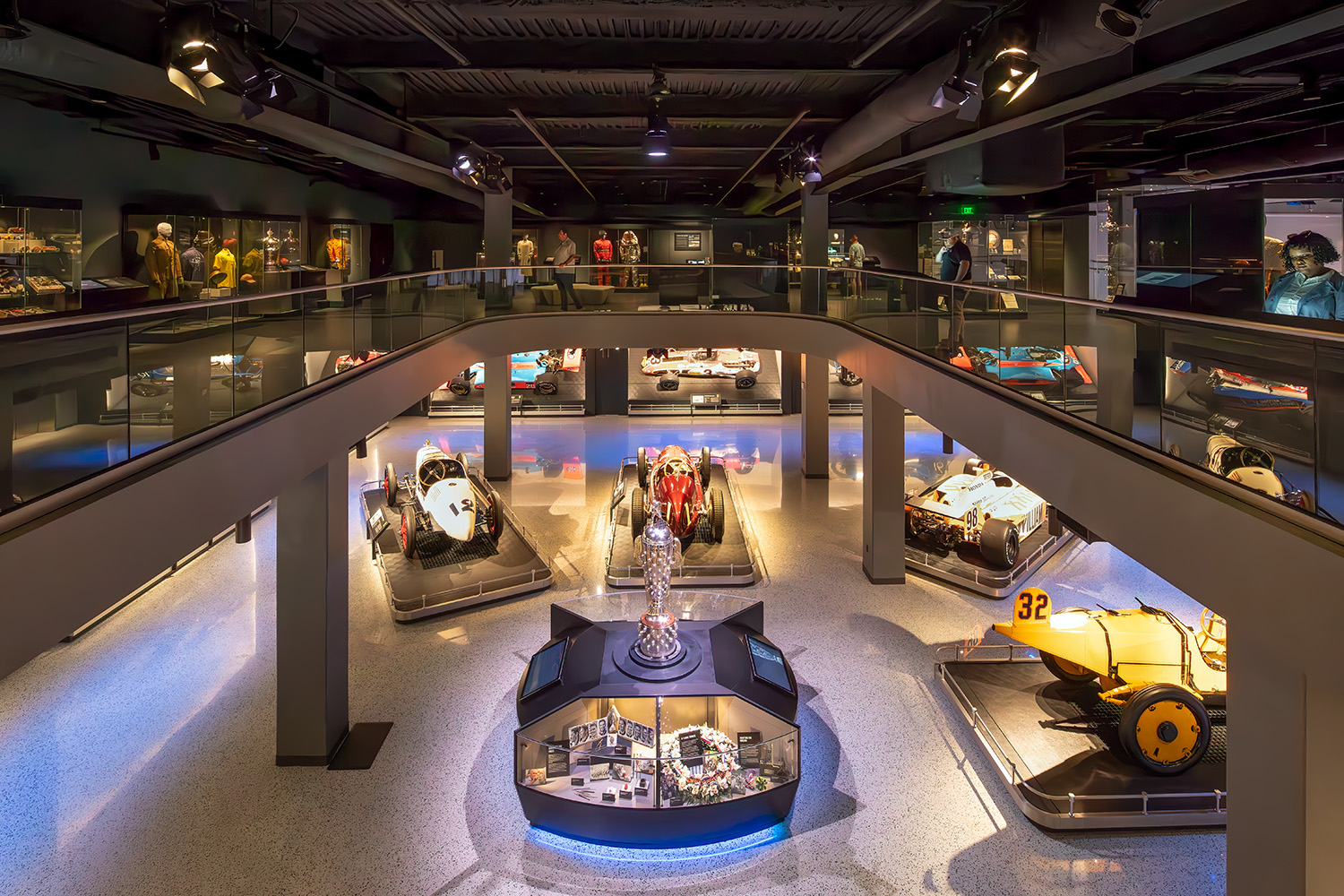
The easy access to the lower level may seem unexceptional nowadays, but only to museum newbies. For decades, it was a place of legend and mystique. “It used to be called the basement,” said Burr, “and you had to really know somebody to get down there and see it.” So what was down there? “A repository of rare, priceless, and one-of-a-kind racing and automotive artifacts and vehicles,” according to one source.
Then, several years ago, the museum began offering exclusive VIP basement tours, charging $150 for a half hour, but even then, the cellar remained secretive. Participants descended in groups of six and were prohibited from taking photos — yet the tours still raised $400,000 for the museum, a not-for-profit entity that has long operated independently of the Speedway.
Today, as part of the Winners Gallery, the former basement still contains rare and one-of-a-kind racing vehicles, and even a secret or two. Look closely at the walls, and you will discover that their banking matches that of the famed oval — 9.2 degrees. But you won’t pay $150 to enter, and no one will hassle you if you take pictures.
FUNDING THE RENOVATION
Speaking of fundraising, given that auction revenue for the museum’s 11 historic automobiles exceeded $100 million, it might seem logical to assume that the proceeds will more than cover the cost of the renovation. But what’s logical is not always ethical in the world of museums. The American Alliance of Museums, which represents 35,000 museums and museum professionals, maintains strict rules pertaining to deaccessioning, the process of removing unwanted objects from museum collections.
Calling deaccessioning a “responsible practice” when an item no longer fits the mission of the museum, the Alliance nevertheless cautions that “if a deaccessioned object is sold, museum professional ethics require the proceeds from the sale be used only to acquire new objects for the collection or provide direct care of the collection.” As former IMS Museum President Joe Hale stated, “We can’t use the proceeds of that sale to build a new museum, but the proceeds will go to two functions: the care of the collection and to enhance our collection.”
In 2023, Hale launched the $89 million “The Stories Behind the Spectacle” capital campaign to fund the renovation of the museum and the construction of an $18 million, 60,000-square-foot Restoration and Event Facility near the track. The structure would replace a pair of nearly 70-year-old, 1,500-square-foot buildings now used to restore historic vehicles.
‘ULTRA-MODERN’ IN 1956
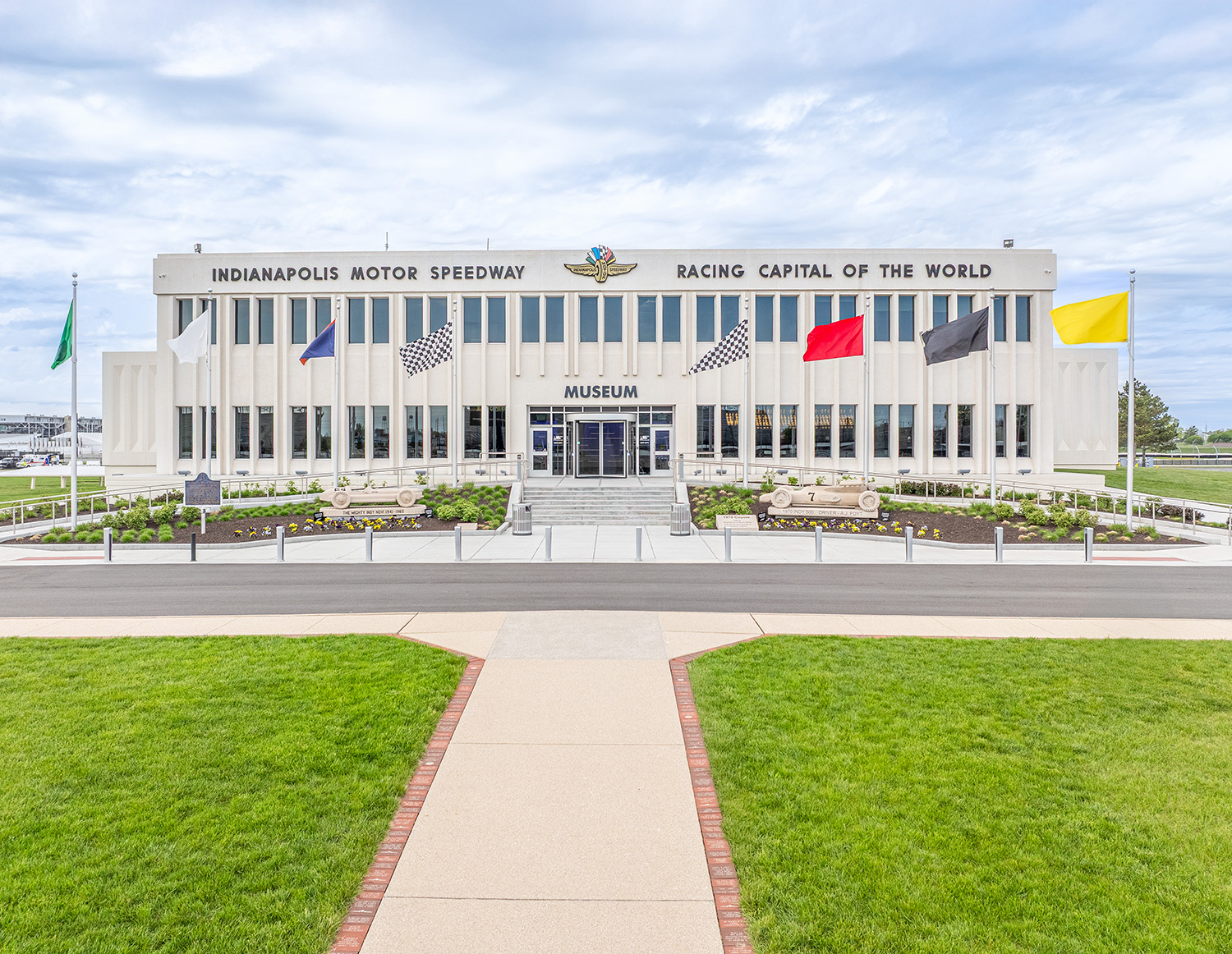
The IMS Museum celebrates its 70th birthday this year. Still, nearly a half-century of racing elapsed before it came into being — and even then, it had to share space with the track’s front office, previously located downtown. The new museum/administration building, situated on the southwest corner of the Speedway grounds, contained 8,000 square feet — only one-tenth the space of the current museum. However, the Indianapolis Star hailed it as an “ultra-modern structure,” citing features such as air conditioning, which was found in only 2 percent of American homes at the time.
Groundbreaking ceremonies for the museum took place in July 1955, but the mood wasn’t entirely jubilant. Thoughts of former Speedway President Wilbur Shaw, who died tragically in a plane crash the previous October, loomed large over the event, amplified by his wife’s presence as an honored guest. Speedway Owner Anton “Tony” Hulman had already announced that the museum would be dedicated to Shaw, whose contributions to the Indy 500 transcended the steering wheel.
One of the greatest race drivers in history, Shaw won three Memorial Day classics and placed second on three other occasions. And his off-track accomplishments proved at least as significant. Not only did he convince Hulman to buy the deteriorating two-and-a-half-mile oval in 1945, but as its president and general manager, Shaw spearheaded the comeback of Indianapolis’ namesake race and racetrack with improvements such as the installation of steel-and-concrete grandstands in place of the aging wooden seating.
Even after his passing, Shaw remained prominent when the museum opened its doors in 1956. Only six historic cars greeted the first visitors to enter the racing shrine, whose exhibits were described as “far from complete.” But not far from the iconic Marmon Wasp stood the Maserati that Shaw piloted to victory in 1939 and 1940.
The museum also featured photos of the winning cars and drivers from previous races, trophies, and other 500 memorabilia dating back to the early 1900s, as well as a Firestone Tire & Rubber Co. display showcasing the evolution of racing tires at Indy.
The Speedway unveiled its new museum on the first day of qualifications, offering a hard-to-beat admission price — free with the purchase of a $1 ticket to enter the track, and more than 10,000 spectators went for it. (Ticket prices would remain ridiculously low for decades — only $5 for adults in 2014 — but are now $25 for adults and $18 for kids 6 to 16.)
The “steady stream of visitors” continued even after the 1956 race, with about 3,500 filing through during the Labor Day weekend, wrote the Shreveport (Louisiana) Journal, adding that the new museum was “rapidly winning recognition as one of the nation’s top tourist attractions.” A guest register showed representation from all 50 states, as well as 25 countries, ranging from Australia to Mongolia.
UPGRADING AND UPDATING
Talk of moving the museum to larger quarters began as early as 1963, when Hulman paid $100,000 to the Town of Speedway for 15 acres across the street from the original building. But ultimately the museum stayed put until 1976, when — amid the hoopla over the nation’s 200th birthday — it relocated to a new 96,000-square-foot, two-story building inside the oval. The Chicago Tribune embraced both the hype and the necessity of the move, reporting that Hulman “built it not only to honor the Bicentennial, but because facilities and parking space at the first museum, opened in 1956, had become inadequate.”
In 2016, foreshadowing the recent renovation, then-Executive Director Betsy Smith voiced concern that the museum had barely evolved in 40 years and was overdue for an update. “The lighting, the technology — it’s vintage 1976,” she told the Star. “I’d like to get some technology in here and some video so that visitors could really experience racing.”
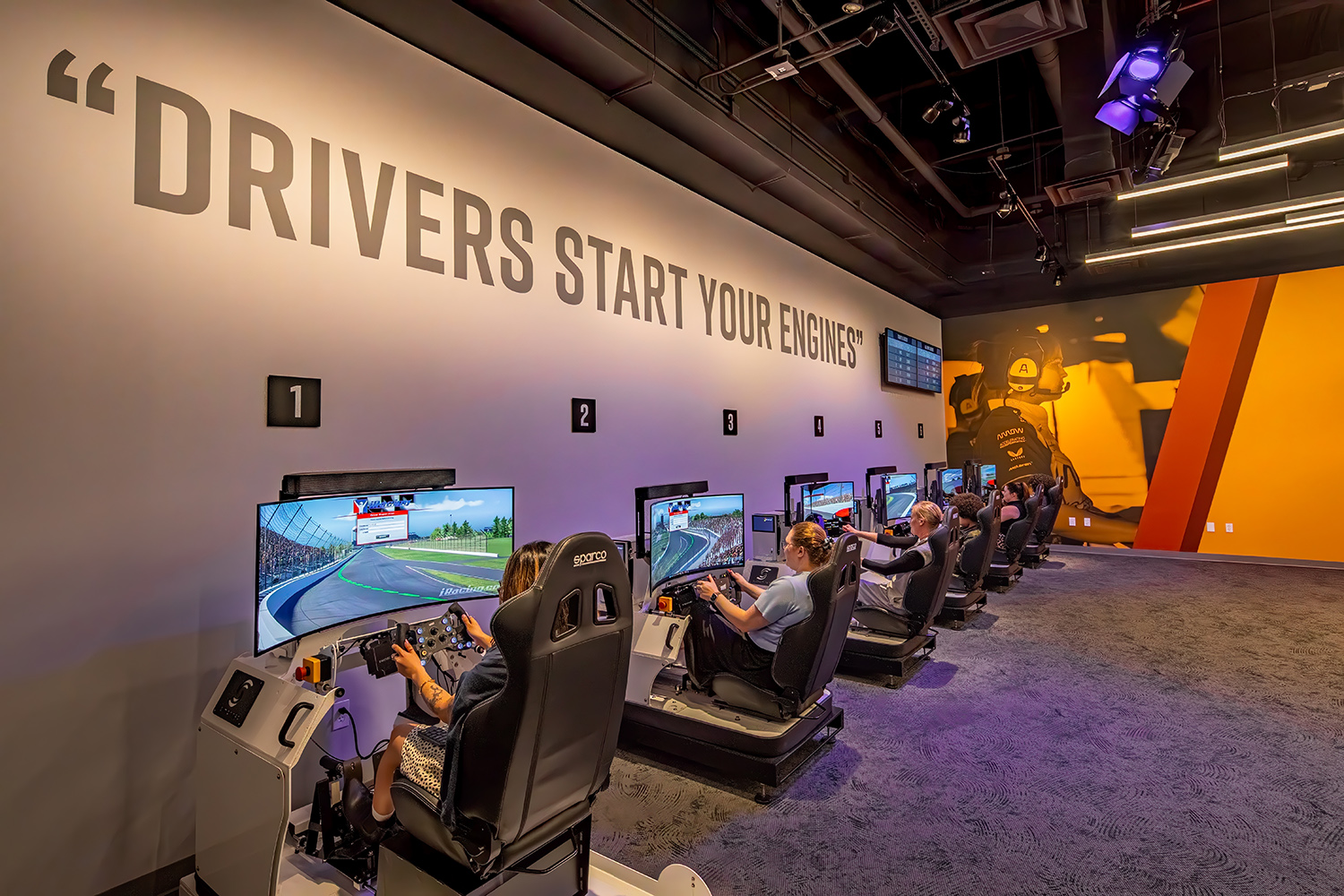
The current galleries provide just that. At the Starting Line Experience, guests enter a room where an 80-by-20-foot LED screen plays a seven-minute video that re-creates the sights and sounds of race day traditions as experienced by Indy drivers on the front row. The video begins with the cannon firing and concludes with the green flag that signals the start of the race, including the “Drivers, start your engines” command that sends the cars roaring to life. Note that this gallery comes with a warning sign cautioning visitors about excessive volume (earplugs are recommended) and flashing lights.
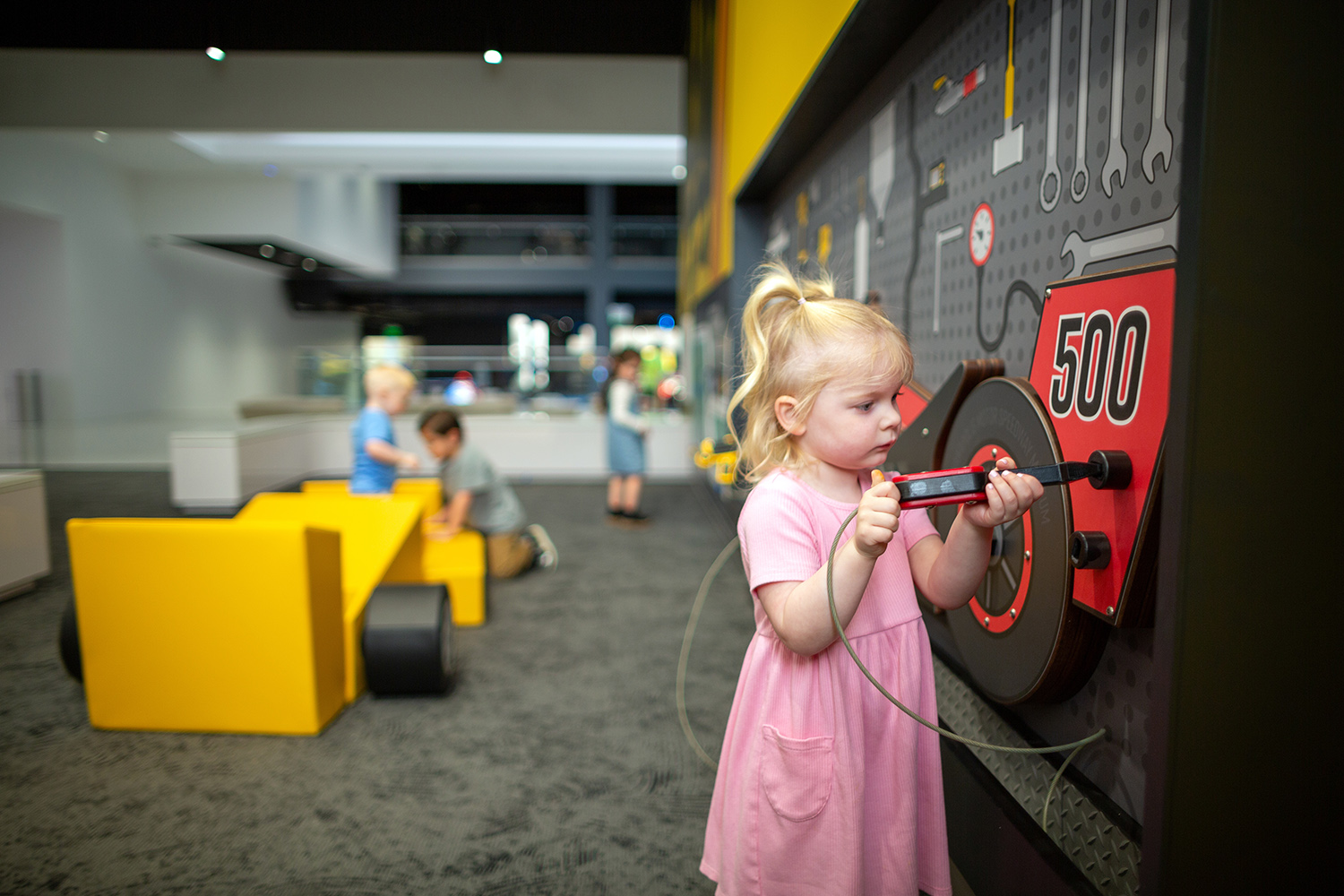
Meanwhile, at Qualifying Zone, museum-goers of all ages can channel their inner A.J. Foyt or Danica Patrick on machines that test reflexes and simulate the experience of trying to qualify at Indy — all the way down to estimated speed and even accidents. The pit stop challenge enables motorheads to learn the tools of the trade, and a play area caters to the youngest future recipients of the Borg-Warner Trophy.
The new museum is already delivering results, as evidenced by attendance figures. Before the renovation, the facility drew about 140,000 visitors annually. However, 2025 saw 150,000 during the first six months following its reopening, said Burr. “Guests have been absolutely loving it,” she said, and some even take the time to express it. “My favorite feedback was, ‘I brought my 3-year-old child and my father-in-law in his 60s, and they both spent hours here.’”