By Stephanie Bernaba
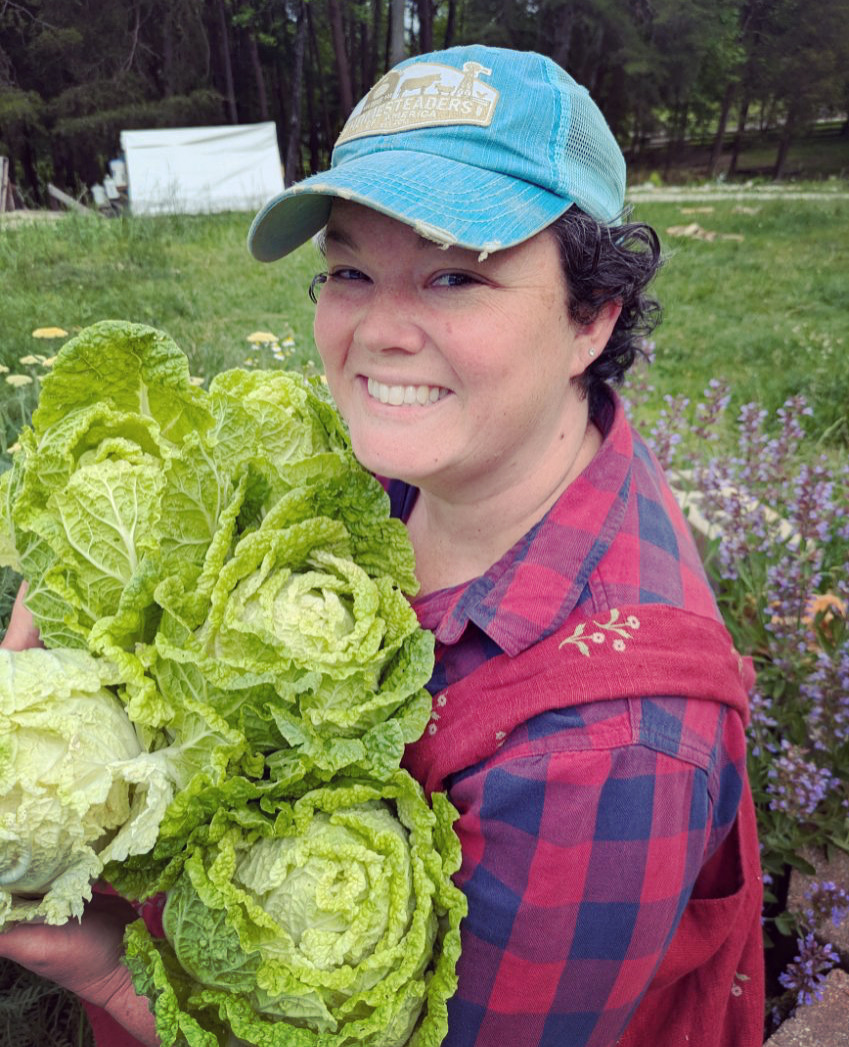
Every Friday evening from May through October, something magical happens at 124 South Mulberry Street in Corydon. Farmers, bakers, beekeepers, and artisan food makers set up booths at the Corydon Farmers Market, and the community shows up to shop, eat, and connect. People linger over lavender lemonades and wood-fired pizzas. Regulars line up early for cult-favorite cookies. Families make it a Friday night tradition.
Harrison County’s local food scene has quietly become one of the most vibrant in southern Indiana. Growers, bakers, and makers built this community on a shared belief that people deserve to know the hands that grew their food.
A market that grows community
The Corydon Farmers Market has been a cornerstone of the local food scene since 2015, when it was established through a Stellar Grant as part of an effort to revitalize downtown Corydon. Now in its 11th season, the market is run by Main Street Corydon and managed by Karen York, who also serves as president of the Main Street Corydon Board.
The market runs every Friday from 4 to 7 p.m. and features 27 vendor booths, all of which are filled this season, with a waiting list for overflow spots. Vendors range from produce growers and meat farmers to bakers, beekeepers, mushroom growers, and artisan crafters.
What makes the Corydon market stand out is not just what is for sale, but the spirit in which it operates. Vendors visit each other’s booths, buy from one another, and incorporate each other’s products into their own.
“The high tide raises all boats,” York said. “I love that our vendors visit each other’s booths. They go and buy the honey and use it in their cookies. They support each other, which makes me want to cry.”
Three vendors — Abruzzo’s Italian Foods and Confections, Ageless Agape, and Precious Lather — have used the market as a launching pad to open brick-and-mortar storefronts in downtown Corydon.
“It allows the vendors an opportunity to see what is popular, what is in demand, what will sell,” York said. “It’s an incubator for businesses downtown.”
The market is free to the public, with vendor fees kept accessible. Permanent vendors pay $150 for the season, while temporary vendors pay $25 per event up to a $150 cap. The market features two covered pavilions on a concrete slab, with electricity for vendors and on-site restrooms.
Singing Trees Keep: The heart of the homestead
Angela de Krieger and her husband, Sang, run a teaching homestead in Harrison County that includes a microbakery, a small-batch fermentation studio, pasture-raised poultry, and workshops to help neighbors reconnect with their food supply.
“Our mission is to produce holistically managed livestock and products to improve food security for ourselves and the surrounding communities,” de Krieger said.
De Krieger began making kimchi in 2014 after her family moved from Los Angeles to Indiana.
Her husband was adopted from South Korea as a child and could not find kimchi locally once the family settled in Indiana. What started as a gift for him became a passion, and by 2019, she was selling fermented foods at the Corydon Farmers Market. She later launched a sourdough microbakery, inspired by her efforts to bake healthier bread for her son’s health.
At her booth, shoppers find fermented vegetables including pineapple-ginger sauerkraut, kimchi asparagus, fermented carrots, and curtido, a Latin American-style ferment, alongside sourdough loaves, muffins, scones, and pancake mixes. Her brown butter chocolate chip cookies have such a following that customers line up 20 minutes before the market opens to secure a bag.
Singing Trees Keep also raises and sells pasture-raised chickens, about 180 last year, and offers sourdough baking workshops and chicken processing classes.
Gypsy Rain Organics: Third-generation roots and a modern vision
Tad Streepey grew up next door to the farm he now runs. His grandmother farmed row crops in Harrison County, his parents were homesteaders, and he spent childhood summers picking tomatoes and milking goats. He created Gypsy Rain Organics as an LLC in 2020.
“From the time we got the farm, I always wanted to do something with it,” Streepey said, “and then COVID hit, and I thought, no better time than now.”
Gypsy Rain Organics now runs a Community Supported Agriculture (CSA) subscription program (a CSA is a direct arrangement where you buy a share of a local farm’s harvest upfront), sells at the Corydon Farmers Market every Friday, supplies vegetables to local restaurants, hosts farm visits, and offers growing classes. Streepey’s offerings include four colors of beets, uncommon greens, and microgreens grown year-round under lights. A new hoop house keeps collards, kale, and spinach producing through winter, and Streepey plans to add two more and launch a winter CSA.
Organic farming here, Streepey explained, is not without challenges.
“Talk to any organic farmer that has grown in this area, and they will tell you this is one of the worst areas in the United States for pests,” Streepey said. His approach relies on neem oil, beneficial nematodes, soil inoculation, caterpillar tunnels, and bug netting, all without synthetic chemicals.
This year, Streepey said, is intentionally a “catch our breath” year, a chance to stabilize before scaling up again. Sourdough bread and locally sourced honey are also available through the Gypsy Rain Organics CSA.
Bee Boy Honey: Sweet work, 50 hives strong
Scott Oliver started keeping bees in 2010 with two hives. Sixteen years later, he manages more than 50 hives across six locations around Corydon. He retired in 2025 from a 34-year career as an industrial water treatment engineer, and beekeeping has become his primary focus.
Oliver and his wife, Carol, run Bee Boy Honey together, selling at the market every Friday. Their line has expanded beyond raw honey to include creamed honey, hot honey, honey sticks, honey-spiced pecans, beeswax soaps, lip balms, hand cream, deodorant, candles, and propolis extract.
His honey-spiced pecans started as an afterthought and now sell out every week in four-pound batches. Because his four-acre property can support only about 15 hives, Oliver has built a network of host properties, all current or former market vendors, providing equipment and labor in exchange for 10% of his annual harvest.
“If we didn’t have beekeepers, I think there’d be hardly any bees left,” Oliver said. “And it’s very rewarding when people tell me how much they enjoy the honey.”
Sowing Seeds Bakery & Blooms: Gluten-free made with care
Sharon Zenor, owner of Sowing Seeds Bakery & Blooms, bakes gluten-free sourdough for families across Harrison County after discovering her own gluten sensitivity. Her signature loaves use a custom 11-ingredient blend of whole-grain flours, starches, and psyllium husk powder, developed over months of experimentation on her family’s 28-acre farm.
“With gluten-free baking, it has to be a blend,” Zenor explained. “It’s a more involved process than baking regular sourdough, but to get the consistency, you have to have the mix.”
Her lineup includes artisan sourdough loaves, gluten-free cinnamon rolls, cookies, pizza crusts, and dinner rolls, with vegan and dairy-free options in development. Orders are accepted through HotPlate.com every other week, and Zenor delivers personally along a route stretching from Harrison County to New Albany and Louisville, Kentucky. Customers can also pick up orders year-round at Backroads Market in Corydon.
The bakery grew entirely by word of mouth after Angela de Krieger tried a loaf and started passing the name to friends. The two now barter regularly, trading bread for pasture-raised chickens.
K&B Liberty Farms: Regenerative, pasture-raised, and mission-driven
Kris and Brittney Hobt bring a unique story to the county’s food scene. Both are U.S. Army veterans who continue to serve their community while running a regenerative farm and raising a family. They joined the Corydon Farmers Market in 2023 and have quickly become a valued part of the vendor community.
The farm specializes in pasture-raised poultry and beef raised using regenerative practices. K&B Liberty hosts Bee Boy Honey hives on its property and carries products from Ageless Agape, a local toxin-free cosmetics company whose formulations use tallow sourced from K&B’s cattle.
Backroads Market: Where local makers find a home
Not every part of the local food scene happens outdoors on a Friday night. Backroads Market, owned by Abby Taylor, provides year-round visibility and a gathering space for the area’s makers, bakers, and artisans. De Krieger drops off bread orders there during the off-market months, and Taylor charges nothing for the dedicated shelving. The space also hosts workshops throughout the year, including fermentation and sourdough classes led by de Krieger.
House Bill 1424: A win for Indiana’s food producers
De Krieger and Streepey of Gypsy Rain Organics spent much of the past year championing legislation that has reshaped what is possible for small food producers across Indiana. When regulatory guidelines threatened to restrict what home-based vendors could legally sell, the two built a grassroots coalition and took their case to Indianapolis.
De Krieger founded an online group, Hoosiers for Food Freedom, that grew to more than 3,000 members statewide and connected with the Institute for Justice and Leah Wilson, president of Stanford Health Freedom.
Together, they rallied support for House Bill 1424, the Farm and Homestead Food Sales Act, authored by Rep. Hunter Smith and co-authored by Reps. Robert Morris, Matt Lehman, and Robb Greene. The bill was sponsored in the Senate by Sens. Brian Buchanan, Gary Byrne, Tyler Johnson, Eric Koch, Blake Doriot, and Stacey Donato.
De Krieger and Streepey testified before the Senate committee, each bringing sons who also testified. Of the roughly 14 people who testified in support, de Krieger estimates at least half were connected through her advocacy group. The bill passed the House 74-12, and Governor Mike Braun signed it into law on March 12, 2026. It took effect July 1.
Homestead and small farm vendors are now exempt from health regulations that previously applied to commercial food establishments, and state and local health authorities are barred from imposing rules or licensing requirements beyond those required by federal law. Vendors may sell specified meat products and other foods from their own property or at a farmers’ market, and may ship and deliver food directly to consumers under specified conditions. Vendors must still provide consumers with product information through signage or labeling, and health departments retain the ability to investigate foodborne illness complaints.
“This will free up not just small farms, but customers too, to choose where they buy and what they feed their family,” de Krieger said. “I truly believe that small farms feeding local communities is the way forward.”
A community worth supporting
These businesses represent a value much greater than the sum of their parts. They are a network of vendors who buy from, barter with, advocate for, and show up together at county health board meetings and Statehouse hearings.
The Corydon Farmers Market continues every Friday through the end of October. Bring an appetite, a bag, and the family. Dinner is waiting.
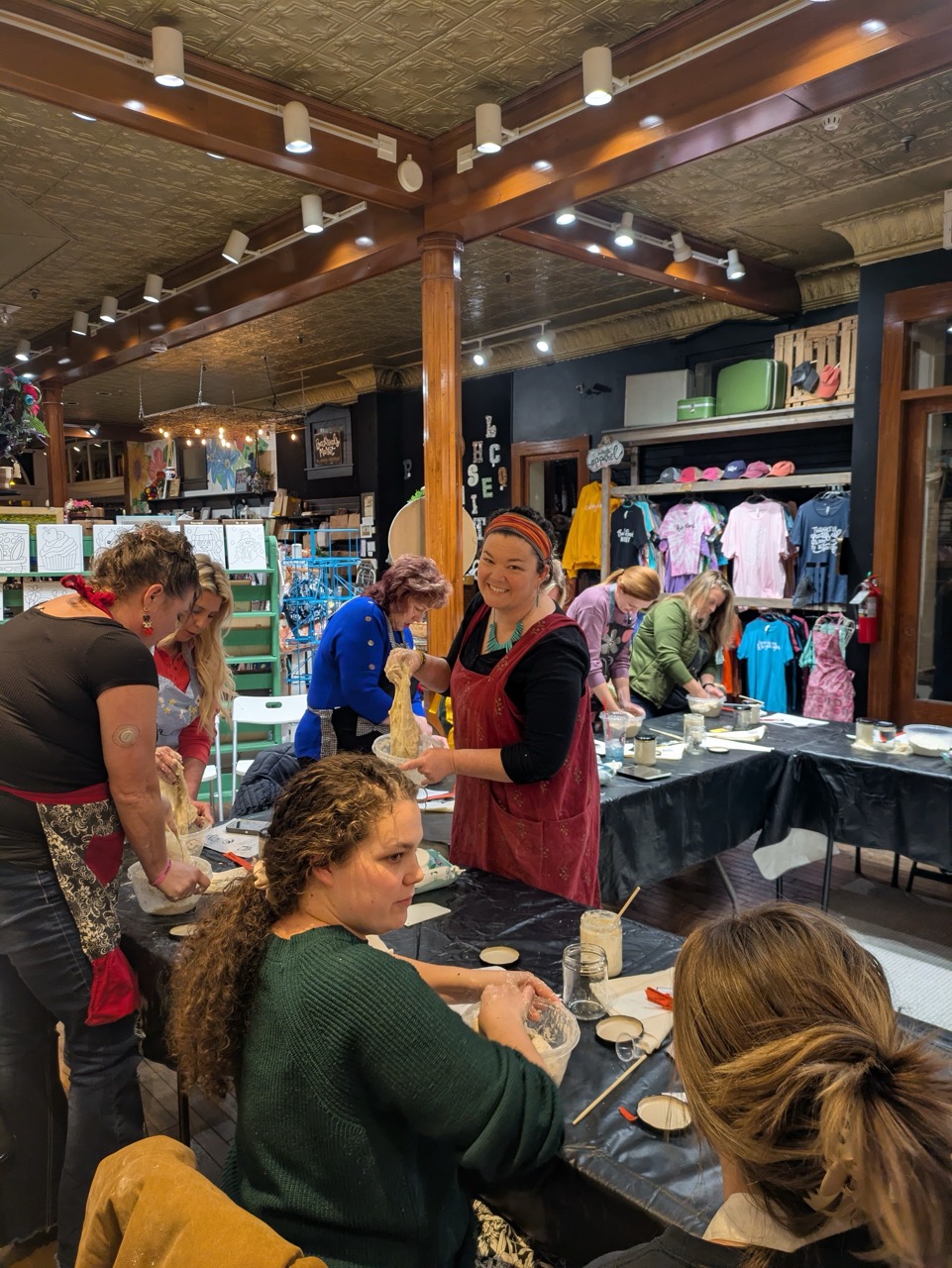
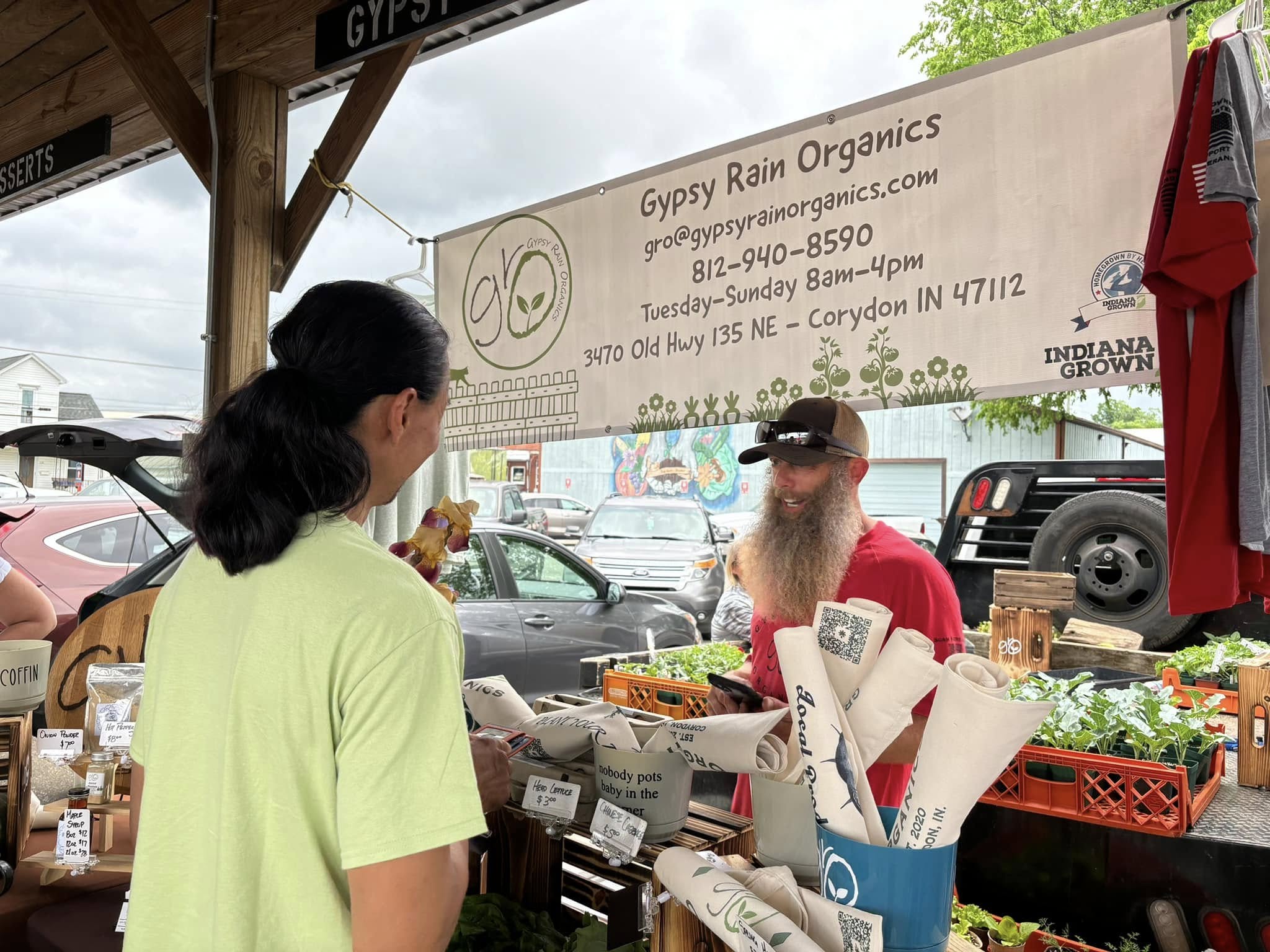
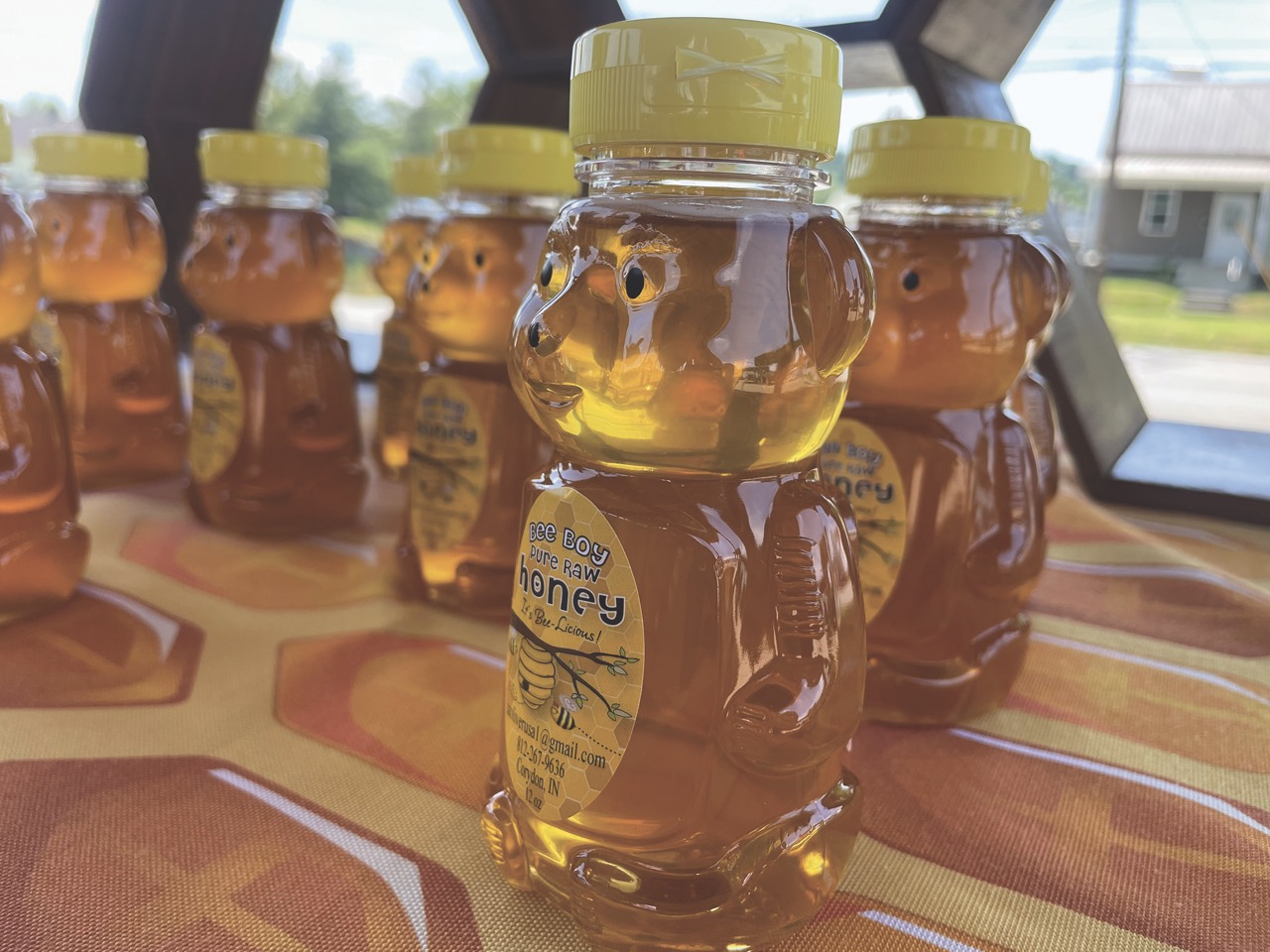
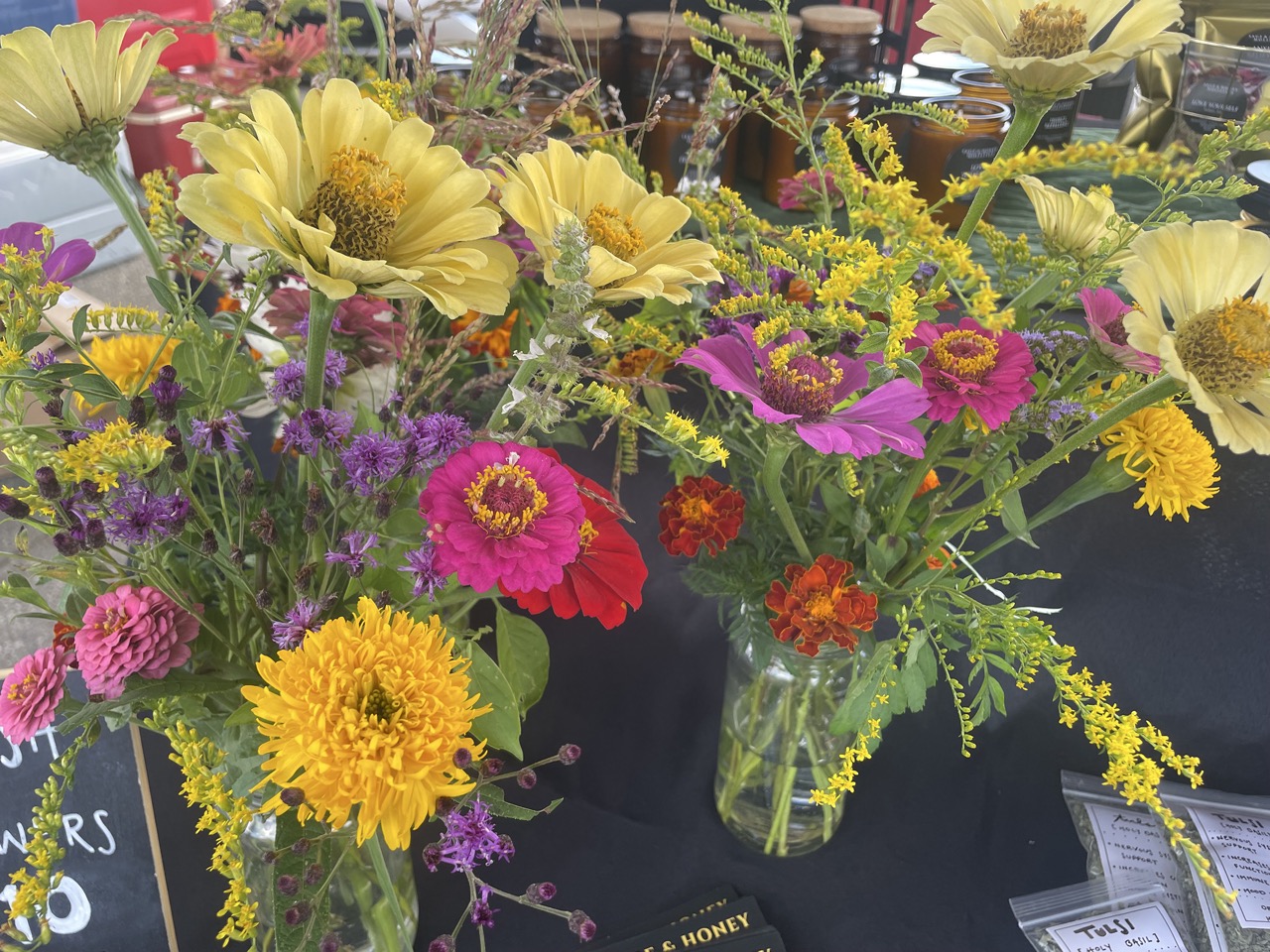
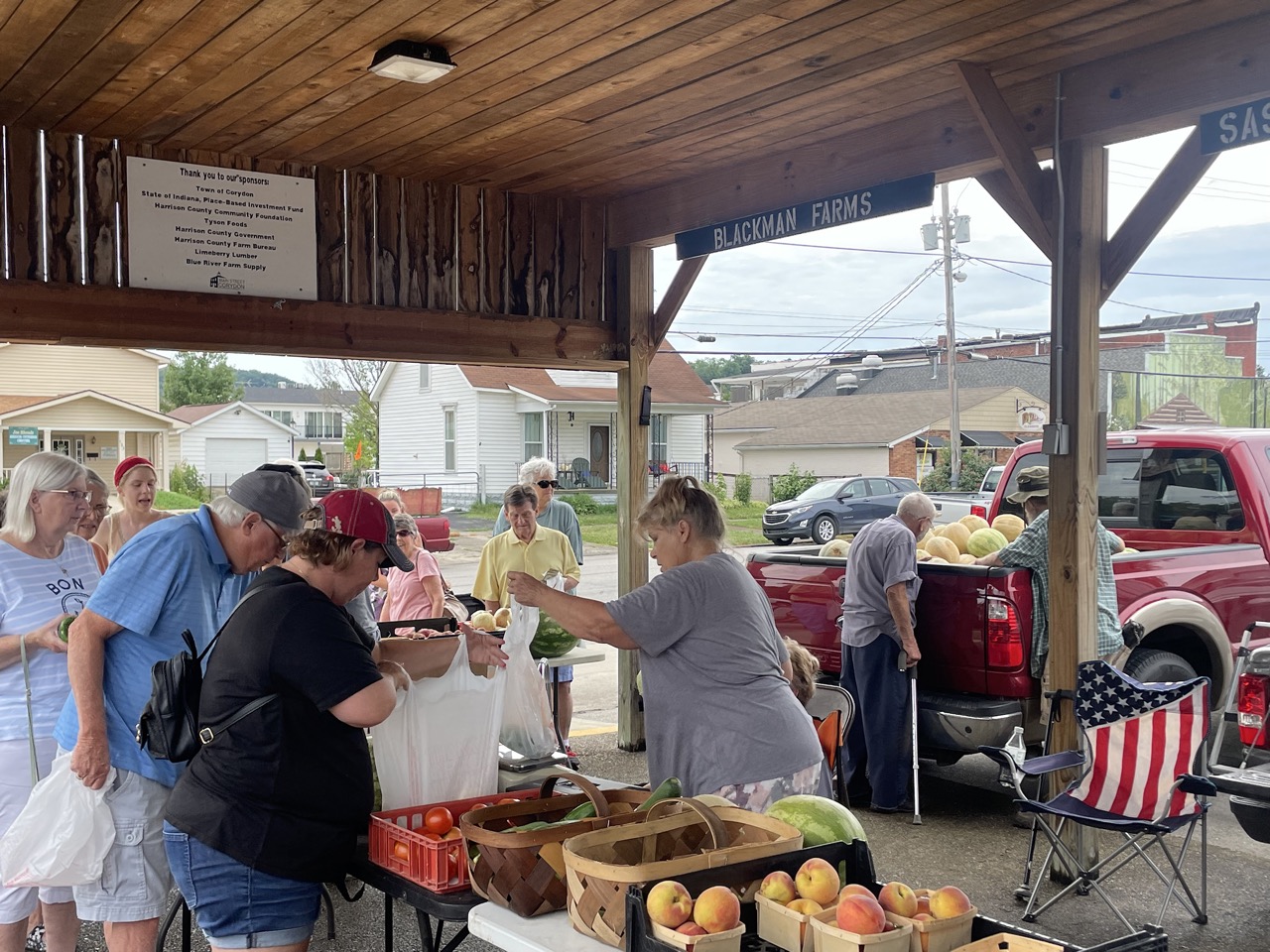
Clockwise from top left:Angela de Krieger teaches a class at Backroads Market in Corydon.; Gypsy Rain Organics offers a CSA program along with their farmers market sales.; Bee Boy Honey manages over 50 hives in six locations around Corydon.; The Corydon Farmers Market offers 27 vendor booths.; Farmers Market vendors range from produce growers and meat farmers to bakers, beekeepers, and artisan crafters. (Photos courtesy of Angela de Krieger and Main Street Corydon)
For a list of vendor contacts and product ordering details, see below:
Corydon Farmers Market
124 S. Mulberry St., Corydon, IN 47112
mainstreetcorydon.org/events/farm-market
Singing Trees Keep
Facebook: Singing Trees Keep
To order: HotPlate.com
Gypsy Rain Organics
3470 Old SR 135, Corydon, IN 47112
gypsyrainorganics.com
gypsyrainorganics@gmail.com
Bee Boy Honey
Facebook: Bee Boy – Honey & Other Bee Related Products
saoliverusa1@gmail.com
Sowing Seeds Bakery & Blooms
Facebook: Sowing Seeds Bakery & Blooms
sharongrace79@gmail.com
K&B Liberty Farms
2254 Fogel Rd SE, Corydon, IN 47112
kblibertyfarms.com
Facebook: K&B Liberty Farms
Backroads Market
201 N Capitol Ave, Corydon, IN 47112
backroadsstore.com
Facebook: @backroadsmarketIN
Instagram: backroadsmarketindiana
backroadsmarketindiana@gmail.com