President and CEO
Since plans were announced to build a data center in Boone County, we’ve heard thoughtful questions from our members. The question we hear most often is: “Where will the electricity come from?”
It’s a fair question, and the answer is a little more complicated than it may seem because electricity doesn’t travel from one specific power plant directly to one consumer.
Large projects naturally generate curiosity, and as your electric cooperative, we believe it’s important to be transparent about our role and responsibilities.
Boone Power does not generate electricity. We build, operate, and maintain the local system that delivers electricity to homes and businesses across the greater Boone County area. As a public utility, Boone Power has a designated service territory and a statutory obligation to serve consumers within that boundary.
Boone Power purchases power from Wabash Valley Power Alliance (WVPA), our generation and transmission partner. WVPA, also a cooperative, is responsible for securing the electricity needed to serve Boone Power’s members.
When approached about potential large projects, Boone Power works closely with WVPA to determine power needs and availability. WVPA’s approach is to align large loads, such as Meta’s Lebanon Data Center, with additional power resources to provide for that demand. This supports economic development while protecting the reliability of electric service for the families and businesses we already serve.
Boone Power, WVPA, and Meta worked together on a “bring your own energy” type of agreement. Meta is investing in a carbon-free generation source to secure electricity to meet the data center’s expected electric demand.
Another common question is whether other Boone Power members will bear the costs of serving the data center. As a not-for-profit cooperative, we operate at cost. Every consumer pays for the electricity it consumes. Large users are responsible up front for the cost of facilities built specifically to serve their load, such as dedicated transformers and substations. We’ve also built significant financial protections and guarantees into the agreement with Meta to ensure project-related costs do not fall back on our members, even if the project is delayed, scaled back, or ultimately does not move forward.
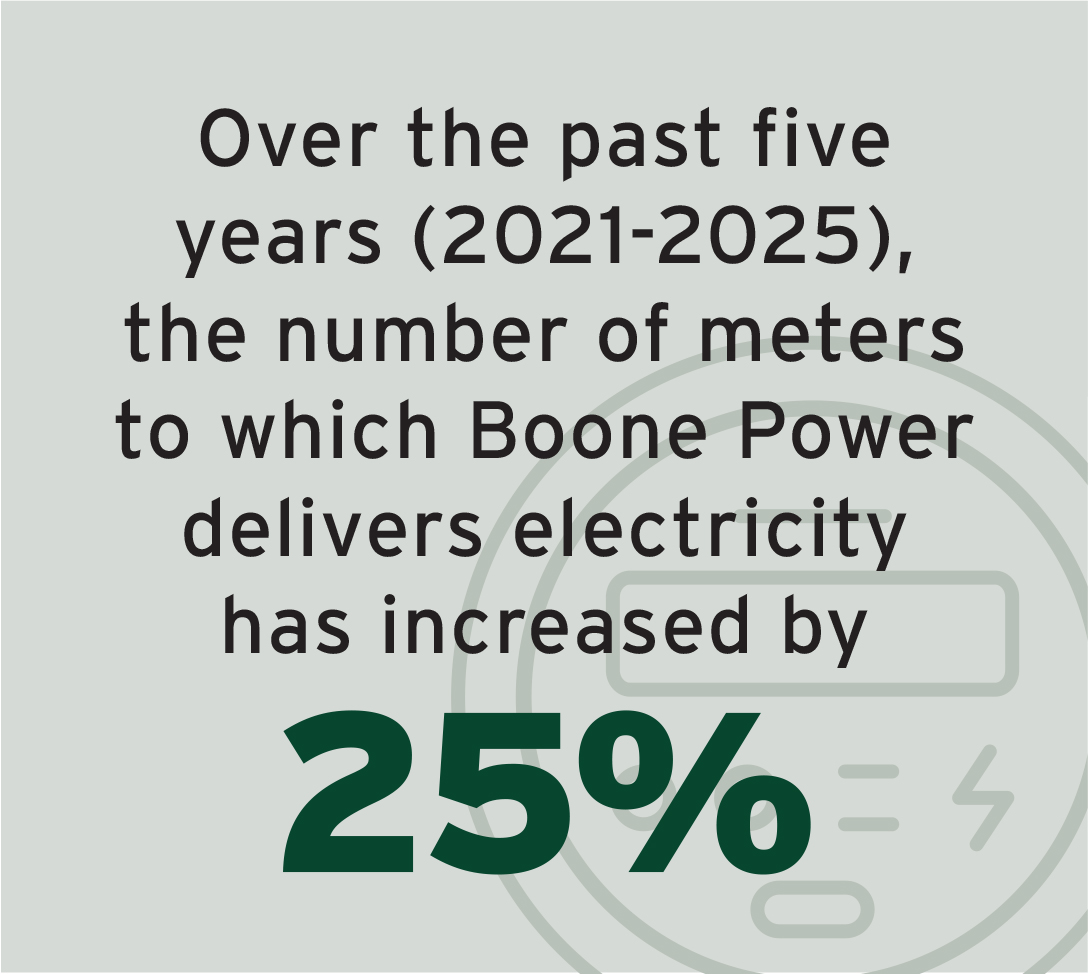
Boone County continues to experience unprecedented growth. New homes and businesses require more electricity. Meeting that demand requires long-term planning years in advance of new development.
The Central Indiana Grid Expansion project, being constructed by WVPA, supports the region’s growing demand for electricity.
The new infrastructure strengthens the reliability our current members expect from us, while also supporting Boone Power’s obligation to serve all the homes and businesses in our service territory, including within the LEAP district. These high-voltage transmission lines become part of the regional grid and can be used by multiple utilities to move electricity where it is needed. Much like a toll road, utilities that use these transmission lines pay fees for that access, offsetting the cost to build the infrastructure.
Growth brings both challenges and opportunities. Our responsibility remains the same as it has always been — making decisions in the best interests of all our members to protect affordability and reliability. We understand that members will continue to have questions as Boone County grows, and we welcome those conversations.
I encourage you to learn more about how we plan for growth while staying focused on reliability at boonepower.com/growth-and-grid-reliability.